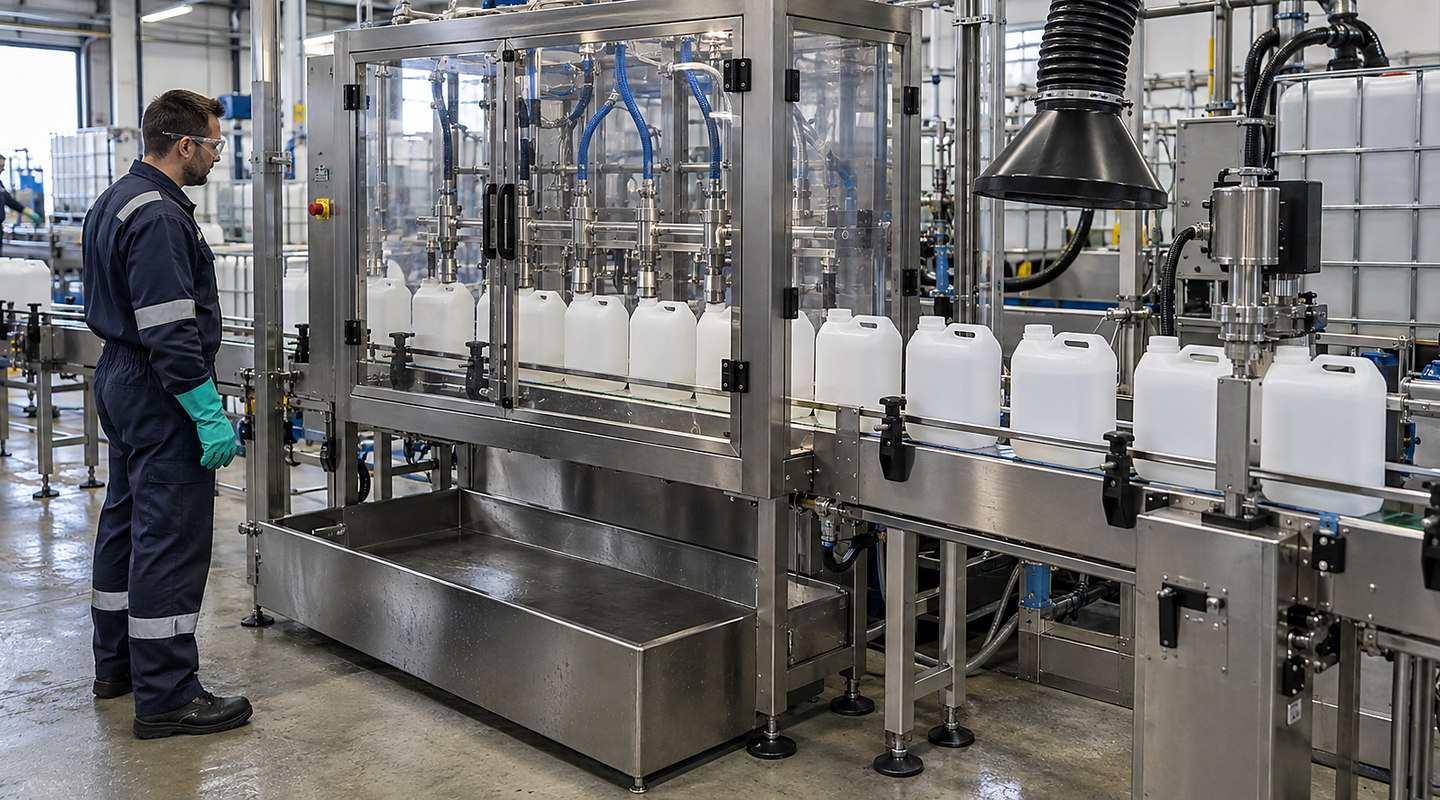
Bucket Filling Lines Selection Guide
Choose bucket filling lines by comparing your parts, process, rate, access, data needs and required results.
Compare bucket-filling concepts using the same product, bucket and target-fill range. Review how each option addresses changes in product behaviour, cleaning, format changes and the finished-pack checks you require.
For routine production using bucket and pail filling lines, a short trial that reproduces the difficult condition is often more useful than a long list of nominal specifications.
Compare options in the conditions where they must work — Bucket Filling Lines
Plan bucket filling lines around your product, pack range, target output, cleaning needs and finished-pack checks. Discuss a practical line concept with Lancing using representative samples. A useful shortlist should show how every option copes with product behaviour and cleaning, access and changeover method.
Discuss your application

Ask every supplier the same questions
| Decision | What to ask | What to check |
|---|---|---|
| Product Behaviour | How do temperature, foam or particles change filling behaviour during a run? | Representative samples and a controlled trial. |
| Bucket and Lid Range | Which bucket and lid sizes, shapes, handles and presentation conditions must be handled? | Representative samples and a controlled trial. |
| Target Fill Weight or Volume | Which fill weights or volumes and acceptance ranges apply to each format? | Drawings, observation and interface measurements. |
| Required Output and Production Pattern | How many accepted closed pails are required, including replenishment and short stops? | Drawings, observation and interface measurements. |
| Cleaning, Access and Changeover Method | Which guides, settings and cleaning tasks change between products or formats? | Agreed operating and acceptance records. |
| Finished-Pack Checks and Reject Handling | How will fill quantity, rim condition, lid seating and rejected packs be checked? | Agreed operating and acceptance records. |
Include simpler approaches to bucket and pail filling lines in your shortlist
| Approach | Often suitable when | Watch for |
|---|---|---|
| Bucket Filling Lines | You need a dedicated solution for a clearly defined duty, product and bucket range and line interface. | The selected method must be trialled with representative product and packaging. |
| Semi-Automatic Equipment for Lower-Volume or High-Changeover Work | Your volumes, product mix or operator judgement make a simpler route more practical. | Check ergonomics, consistency and safe access before choosing the lower-complexity option. |
| Fully Automatic Line Integration where Repeatable Container Flow and Rate Justify It | Your surrounding process is stable enough for a broader automated solution to add value. | Allow for line connections, fault recovery and maintenance as well as the headline equipment. |
Pause before choosing when…
- Only perfect or hand-selected examples of routine production using bucket and pail filling lines are available.
- No one has defined how finished-pack checks and reject handling will be evaluated.
- The normal range for product behaviour is described only as “usually fine” but has not been bounded.
- Your operator, cleaning, maintenance or recovery access has not been considered.
- Quoted performance depends on another machine or data source that is not included.